Lua Rank's AI Optimization Features Explained
 Louis LuaAI Visibility Analyst at Lua Rank
Lua Rank features explained: 13-layer AI assessments, a 12-month execution calendar, and multi-model visibility tracking across ChatGPT, Perplexity, and Google AI Overviews.

Most AI search tools do one thing: they tell you what is wrong. They scan your site, produce a report, and leave you to figure out what to do next. That is useful, but it is not a programme. It is a starting point.
We built Lua Rank to go further. Not just diagnosis, but a complete execution system covering assessment, planning, scheduling, implementation, and tracking. Here is a clear breakdown of how each feature works and what it actually does for your AI visibility.
The 13-Layer Website Assessment
When you connect your site to Lua, we run it through 13 distinct optimisation layers. This is not a standard technical SEO audit. These layers are designed specifically to evaluate how well your content, structure, and authority signals perform within AI model workflows.
What the layers cover
The assessment spans areas including structured data implementation, entity clarity, topical authority signals, content extractability, source credibility markers, and citation readiness. Each layer is scored independently, so you get a precise picture of where you stand rather than a vague overall health score.
This matters because AI models like ChatGPT, Perplexity, and Google's AI Overviews do not rank pages the way traditional search engines do. They extract, synthesise, and cite. If your content is not structured to be extracted cleanly, it will not be cited, regardless of how well it ranks organically. Harvard Business Review's analysis of how generative AI disrupts knowledge work reinforces why content that is built for AI extraction is increasingly the competitive differentiator.
Competitor benchmarking built in
The assessment does not evaluate you in isolation. We run the same 13-layer scan against your named competitors, so you can see where they are ahead and where you have an advantage to press. This is the kind of context that changes decisions. Knowing your structured data score is 61 out of 100 means little. Knowing your primary competitor is at 78 tells you exactly how urgent the gap is.
The 12-Month Execution Programme and Task Scheduling
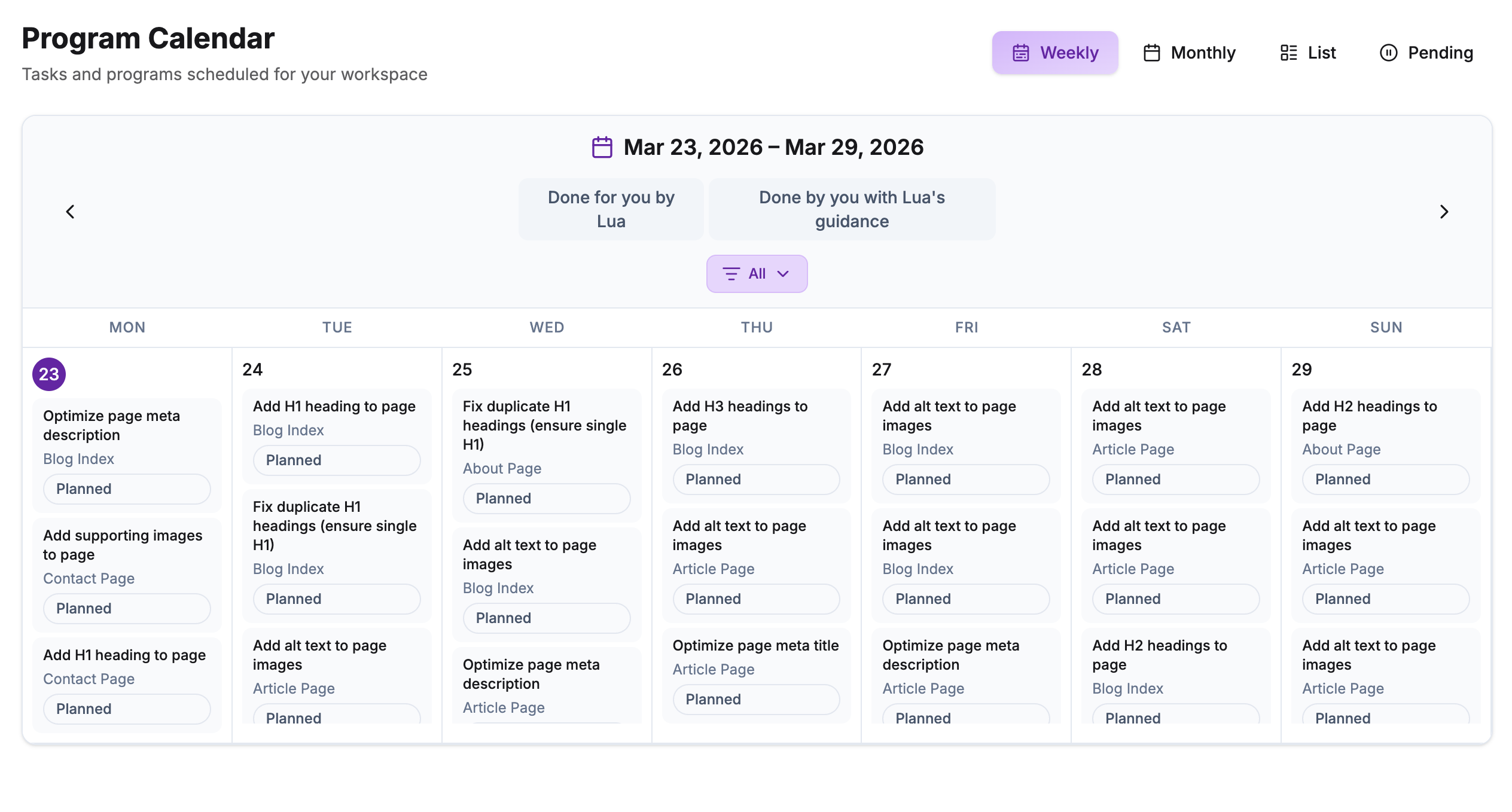
This is where Lua's AI optimization features separate from every other tool in this space. Once the assessment is complete, Lua generates a fully sequenced 12-month programme tailored to your brand, your site, and your competitive position.
Day-by-day task scheduling
The programme is not a list of recommendations. It is a calendar. Every task is scheduled to a specific day, with clear instructions on what to do, how to do it, and which platform you are doing it on. A marketing director running a 3-to-5-hour weekly implementation schedule can follow it without guesswork.
Tasks include content creation briefs, structured data implementations, internal linking work, schema additions, and entity reinforcement activities. For each one, Lua provides the exact output, whether that is a content brief, a JSON-LD snippet, or a set of CMS-specific instructions for platforms like WordPress, Webflow, or Shopify.
Automated task execution
Some tasks do not require manual effort at all. Lua executes a subset of optimisation tasks automatically in the background, reducing the implementation burden on your team. This is particularly valuable for smaller marketing teams where bandwidth is the real constraint.
Feature | Other AI Visibility Tools | Lua Rank |
|---|---|---|
Website assessment | Partial (varies) | 13-layer structured audit |
Execution planning | Recommendations only | 12-month day-by-day calendar |
Implementation guidance | Generic advice | Exact content, code, and CMS instructions |
Automated execution | No | Yes (selected tasks) |
Multi-model tracking | Limited | ChatGPT, Perplexity, Google AI Overviews, Claude |
Competitor benchmarking | Rarely included | Included across all layers |
Multi-Model Visibility Tracking and Progress Monitoring
Doing the work is only half the equation. Knowing whether it is actually working is the other half. Lua tracks your brand's visibility across four AI platforms: ChatGPT, Perplexity, Google AI Overviews, and Claude.
What visibility tracking actually measures
We track whether your brand is being cited in AI-generated answers, how prominently, and in response to which query types. This is distinct from traditional keyword ranking. A brand can rank on page one of Google and still be entirely invisible in AI search. The ranking tools that matter here are the ones built to measure citation frequency and source authority within AI model responses, not just organic positions.
The global shift in search advertising spend tracked by Statista reflects a broader transition in how people find information. AI-assisted search is becoming a primary discovery channel across markets, and visibility within those systems is now a distinct, measurable objective.
Progress tracking against your baseline
Every improvement you make feeds back into a visibility score that updates over time. You can see the trajectory: where you were at the start of the programme, where you are now, and how that compares to competitors who are also operating in your space. Brands currently on Lua have achieved first-page ChatGPT rankings in under 40 days from programme start. That is not a theoretical outcome. It is what happens when the assessment, the plan, and the implementation are all aligned.
A fair counterargument to consider
We do hear one reasonable objection: AI search is still evolving, and investing heavily in a channel that could shift significantly carries risk. That is a legitimate point. The models change. Citation behaviours are not fully transparent. McKinsey's research on the economic potential of generative AI highlights both the scale of the opportunity and the uncertainty that comes with it.
Our position is that the underlying work required for AI visibility, which is producing clear, well-structured, authoritative content, is not wasted effort if AI search evolves differently. It compounds. A brand that builds genuine topical authority and citation credibility today will benefit across both AI and traditional search channels.
Where this is heading
We expect multi-model visibility tracking to become as standard as Google Analytics is today. As more purchasing decisions are influenced by AI-generated recommendations, the businesses with established citation histories will have a structural advantage that is very hard to close quickly. The window to build that position ahead of competitors is narrowing. Early movers in AI visibility are already accumulating citation authority that late entrants will need significantly more time and budget to replicate.
Lua's content features, execution calendar, and tracking infrastructure are designed for exactly that scenario: getting businesses into AI search results while the competition is still deciding whether it matters.
Frequently Asked Questions
How is Lua Rank different from a traditional SEO tool?
Traditional SEO tools are built to improve performance in Google's organic search results. Lua is built specifically for AI search visibility, meaning ChatGPT, Perplexity, Google AI Overviews, and Claude. The optimisation signals that matter in AI search, such as entity clarity, content extractability, and citation authority, are different from traditional ranking factors. Lua assesses these specifically, builds a programme around them, and tracks results across AI platforms, not organic positions.
How much time does a team need to dedicate to the programme?
The programme is designed for a marketing professional who can commit roughly 3 to 5 hours per week. Lua handles the assessment, generates the plan, schedules every task, provides the exact implementation outputs, and executes some tasks automatically. The human effort required is focused and directed, not open-ended or exploratory. You are following a structured calendar, not figuring out strategy from scratch.
Can Lua Rank be used without prior experience in AI search or GEO?
Yes. The platform is built for marketing teams who are serious about AI search but may not have deep expertise in generative engine optimisation (GEO) or answer engine optimisation (AEO). Every task comes with platform-specific instructions, and Lua's execution calendar removes the need to prioritise or sequence work independently. Teams with existing SEO experience will find the transition natural. Teams without it will find the guided structure sufficient to move quickly.
Related articles
Lua Calendar: Your Day-by-Day AI Visibility Action Plan
Lua Rank's AI visibility program calendar maps your optimization tasks day by day for a full year, telling you exactly what to do and when.
 Guilherme Hortinha
How Lua Rank Supports Growing Agencies
Lua Rank team service helps growing agencies scale AI visibility without hiring specialists. Reduce onboarding to 4 hours and boost content output by 300%.
Louis Lua